


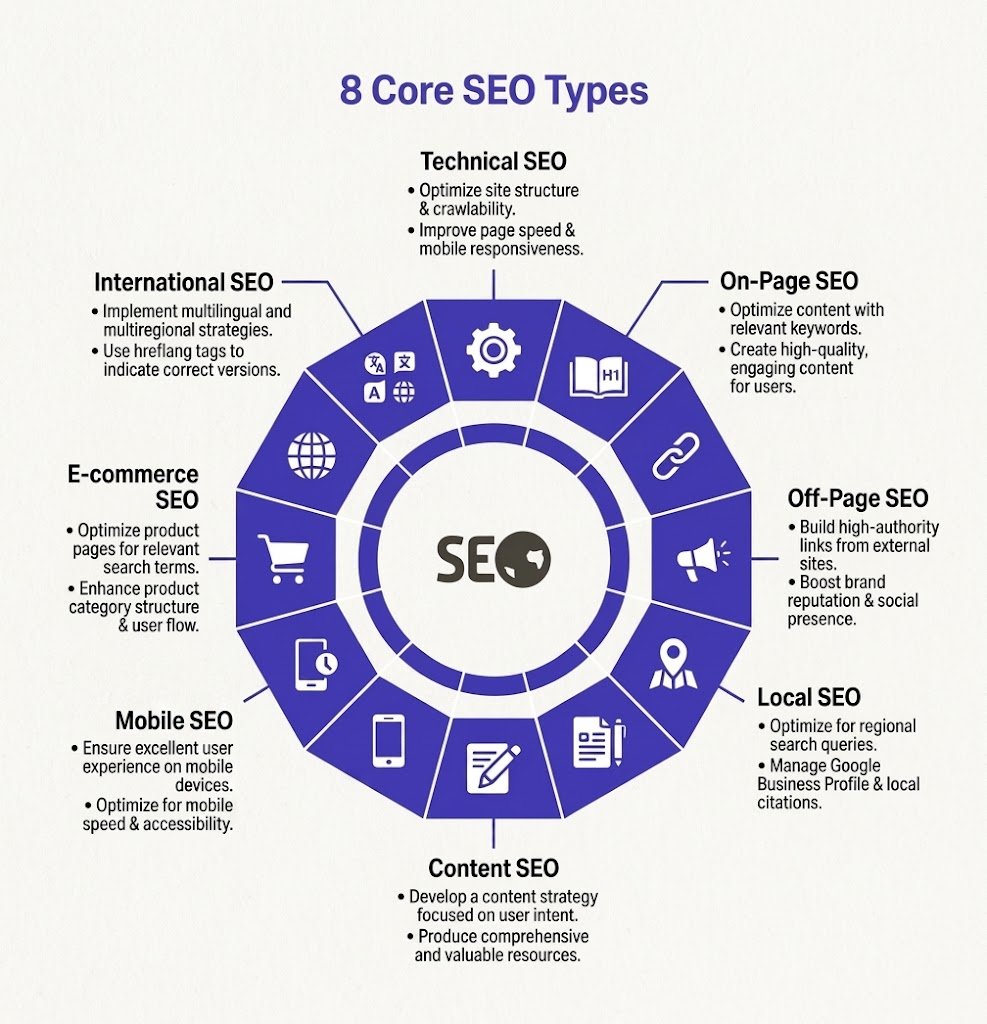
Quick answer: There are 8 core SEO types, Technical SEO, On-Page SEO, Off-Page SEO, Local SEO, Content SEO, Mobile SEO, E-commerce SEO, and International SEO, each targeting a different part of how search engines and AI answer engines find, understand, and rank a website. Most successful campaigns combine several types rather than relying on just one.
Search engine optimization isn’t a single tactic it’s an umbrella term covering multiple disciplines that work together to improve visibility on Google, Bing, and increasingly, AI-driven answer engines like ChatGPT, Perplexity, and Google’s AI Overviews. Understanding which SEO types applies to your situation is the first step to building a strategy that actually moves rankings, traffic, and revenue.
Below is a breakdown of every major SEO type, what it does, and when to prioritize it.
1. Technical SEO
Technical SEO ensures search engines can crawl, render, and index your website efficiently. Without it, even the best content can go unseen.
Key focus areas:
- Site speed and Core Web Vitals (LCP, INP, CLS)
- Crawlability, XML sitemaps, and robots.txt configuration
- Mobile-friendliness and responsive design
- Structured data (Schema markup) for rich results
- HTTPS security, canonical tags, and duplicate content control
- Fixing broken links, redirect chains, and crawl errors
Technical SEO is foundational if a search engine can’t crawl or understand your site, nothing else matters.
2. On-Page SEO
On-page SEO optimizes individual pages to rank higher and earn more relevant traffic. It’s where content strategy meets search intent.
Key elements:
- Keyword research and strategic placement (titles, headers, body)
- Meta titles and meta descriptions written for CTR
- Header tag hierarchy (H1–H3) for readability and crawlability
- Internal linking structure
- Image optimization (alt text, compression, file naming)
- Content depth, originality, and topical relevance (E-E-A-T)
3. Off-Page SEO
Off-page SEO builds authority and trust signals outside your own website primarily through backlinks and brand mentions.
Key tactics:
- High-quality backlink acquisition (guest posts, digital PR, outreach)
- Brand mentions and citations across the web
- Social signals and influencer collaboration
- Online reputation management
- Forum and community engagement (Reddit, Quora, niche forums)
Google treats backlinks as a vote of confidence but quality and relevance outweigh quantity every time.
4. Local SEO
Local SEO helps businesses rank in geographically relevant searches critical for service-based businesses, retail, and multi-location brands.
Key components:
- Google Business Profile (GBP) optimization and consistent posting
- NAP (Name, Address, Phone) consistency across directories
- Local citations and location-specific landing pages
- Review generation and management
- Localized keyword targeting (“near me” and city-specific terms)
For agencies managing multiple client locations, Local SEO is often the fastest path to measurable ROI.
5. Content SEO
Content SEO focuses on creating and structuring content that satisfies search intent while aligning with how both traditional search engines and AI answer engines extract information.
Key practices:
- Search intent mapping (informational, navigational, transactional, commercial)
- Topic clusters and pillar-page architecture
- Content freshness and regular updates
- Clear, scannable formatting (short paragraphs, lists, tables)
- E-E-A-T signals: author credentials, citations, original data
6. Mobile SEO
With mobile-first indexing as the standard, mobile SEO ensures your site performs well specifically on smartphones and tablets.
Key focus areas:
- Responsive, thumb-friendly design
- Fast mobile load times and lightweight assets
- Avoiding intrusive interstitials and pop-ups
- Tap target sizing and mobile UX
7. E-commerce SEO
E-commerce SEO is a specialized branch optimizing product and category pages for both search visibility and conversions.
Key elements:
- Product schema markup (price, availability, reviews)
- Category page optimization and faceted navigation control
- Unique product descriptions (avoiding manufacturer duplicate content)
- Site architecture for large catalogs
- Shopping feed optimization (Google Shopping, Merchant Center)
8. International SEO
International SEO targets audiences across multiple countries or languages using proper technical and content structuring.
Key components:
- Hreflang tag implementation
- URL structure (ccTLD, subdomain, or subfolder strategy)
- Localized content and currency/language targeting
- Region-specific keyword research
AEO and GEO: The New Layer of SEO
Two newer disciplines now sit alongside traditional SEO:
- AEO (Answer Engine Optimization) Structuring content to be directly extracted as answers by voice assistants and featured snippets, using clear Q&A formatting, concise definitions, and structured data.
- GEO (Generative Engine Optimization) Optimizing content so AI systems like ChatGPT, Perplexity, and Google AI Overviews cite and reference your brand as a source, which relies heavily on clarity, factual accuracy, original data, and strong E-E-A-T signals.
Both build on the same foundation as traditional SEO but prioritize direct, quotable, well-structured answers over keyword density alone.
Which SEO Types Should You Prioritize?
| Business Goal | Priority SEO Types |
|---|---|
| Local customers/foot traffic | Local SEO + On-Page SEO |
| Online store sales | E-commerce SEO + Technical SEO |
| Brand authority & backlinks | Off-Page SEO + Content SEO |
| Global expansion | International SEO |
| Voice/AI search visibility | AEO + GEO |
Most businesses need a blend of at least three or four types working together technical health, strong content, authority building, and intent-matched targeting.
FAQs
Q1: What are the main SEO types?
The main types are Technical, On-Page, Off-Page, Local, Content, Mobile, E-commerce, and International SEO, plus emerging disciplines like AEO and GEO for AI-driven search.
Q2: Which SEO types is most important?
Technical SEO is foundational since it affects crawlability and indexing, but On-Page and Content SEO typically drive the most direct ranking and traffic gains.
Q3: What is the difference between SEO, AEO, and GEO?
SEO targets traditional search rankings, AEO optimizes content to be pulled as direct answers (snippets, voice search), and GEO focuses on getting cited by AI tools like ChatGPT and Google AI Overviews.
Q4: How long does SEO take to show results?
Most SEO strategies show measurable movement in 3–6 months, with significant results typically appearing between 6–12 months depending on competition and starting authority.
Conclusion
SEO is no longer a single tactic it’s a system of interconnected disciplines, each solving a different piece of the visibility puzzle. Technical SEO builds the foundation, On-Page and Content SEO drive relevance, Off-Page SEO establishes authority, and Local, E-commerce, and International SEO tailor strategy to specific business models.
Layered on top, AEO and GEO now determine whether your brand gets surfaced in voice answers and AI-generated responses. The businesses winning in 2026 aren’t choosing one type of SEO over another they’re combining the right mix based on their goals, audience, and competitive landscape, then continuously refining based on performance data.